I ran into an interesting article (thank you Kelly!) from one of my friends on Facebook called "
To Have or Have Not-A Baby" which discusses motherhood or childfree living. This article led to an interesting discussion among my intellectual mother friends and it got me thinking about my own motherhood and how I have made mothering more intellectual experience.
This is what my cousin Alyssa commented:
"I was especially interested in this: "According to the author of the book The Intelligence Paradox, maternal urges drop by 25 percent with every extra 15 IQ points. Although he opines that such women are too smart for their own good, one could also infer that you’re dumb if you have kids."
I can't prove it scientifically, but I would argue that the more intellectual women have a hard time facing the mundanity of motherhood. Realistically, the day ins and outs of having small children are often boring, and not intellectually challeging (I think you can make them more interesting, but some tasks are inherently boring, like cleaning). Also, at first, you are around little ones with sometimes limited interaction with adults. Women who need that intellectual stimulation may be less likely to decide that want to make the sacrifices motherhood requires. I have struggled with that in the past, and having Lennon was definitely a spiritual and heart-driven decision rather than an intellectual one. The hardest part is you don't really see the rewards of motherhood unless you actually HAVE children. It's a leap of faith."
And this was my response: "
I absolutely agree that motherhood is a leap of faith. After being told, though, that motherhood would be a waste of my brain, I must admit that I've found it to be the opposite in many ways. At first, it felt that life at home with just a little baby was a brain drain. BUT, I discovered that taking my role of mother and turning it into teacher added a whole intellectual component. The Teach Your Baby series was a huge help with this when my babies were just adorable blobs. Knowing how to teach them at that stage and learning more about brain development than I ever thought I'd know, changed my perspective on my babies from blobs to brain-geniuses. Knowing that they were learning at the fastest rate they would in their entire lives--and that I could add to that learning in an intentional way--WOW that has been very intellectually demanding. And has given me tremendous experiences as a teacher-mom. This has continued as I have homeschooled my children.
I can't say it's easy though!
But it's because of my experiences teaching my children that I've written children's books, taught essay writing and Shakespeare, all these life-enriching experiences that I'm currently enjoying have stemmed from being a Mom.
Was motherhood a change from being a college student preparing for law school or a career woman? Yep!
Was it a difficult adjustment? In many ways, yes.
Was it worth it for me? Absolutely yes.
Do I go around telling other women that they need to make my same choices? Nope.
And now I must do some of the mothering un-intellectual work and help my young son in the bathroom. TMI? Just part of motherhood!!"
Since this discussion, and after assisting my son with his bodily functions, I've fielded some questions about the Teach Your Baby series, which I thought I'd answer here (see sidebar to the right for a Amazon link to the books).
The series is based on fun, enthusiastic presentation of flashcards. If it's not fun, then don't do it. And that's for the naysayers who think that babies should learn without any parental guidance. I think parents are the primary teachers for their children and I think that begins at birth. But what do we teach during the blob stage? This series gave me those answers!
Teaching Baby How To Read uses white cardstock (cut in strips from a poster board or just 8.5x11 white cardstock) and a big fat red marker for the flashcards. We write out, (no cursive) one word per paper, words baby finds most interesting, starting with "Mommy" and "Daddy" all the way to "Tyrannosaurus Rex" (if your baby is like my babies! :) ). My son, who is recovering from autism, learned to speak by learning to read this way. Two of my other children became speed readers with this system. It works! And we were not rigid about it. For about three months I was the most consistent with it. We did flashcards at least twice a day, particularly before nap, bedtime, and after diaper changing. I'd keep a set of 10 cards close to those places so I could speed through them and then we'd be done. When I was lying on the couch sick with morning sickness, I'd keep a stack under the couch. I'd motion then over, show them the cards, and then wave them away feeling like I'd done something for their brains that day (it was helpful for my moral during very sick pregnancies).

Teach Your Baby Math is taught with red dots on the cards showing "how much" rather than the symbolic number which doesn't SHOW numerical value. Makes so much sense, right? We were mainly consistent with the first 20 cards. We were missing card number 15, and when my daughter learned to speak and count, she kept skipping card 15. Which proves that the system works. She's 16 now and bears no scars for missing that card, she can count to 20 just fine (and higher!! :) ). Which proves that my mistakes as a parent are overcome-able! :)
The idea behind
Teach Your Baby Encyclopedic Knowledge is that children before age six are learning at such a high rate, that any facts we intentionally expose them to will be filed away with the rest, useful as a foundation for later when they're older and prepared for actual knowledge and understanding. For example, even if a child hasn't met a dog before, if she has been exposed to 10 cards showing different breeds of dog, she'll have a sense of what "dog" is, and when she meets a dog for the first time she'll recognize it as a DOG. I showed 10 cards of different insects to my son before he was speaking much. Over a year later, when he was speaking some but not tons, we were in a Science museum and my son walked over to the insect display and said, "Giant Walkingstick," pointing to the, er,
Giant Walkingstick. These cards developed a great interest in Science. Although it was fun for him, I think Science is a big part of the economic future so I'm delighted that he has a foundation in it. And it's made learning Science easier as he's grown.
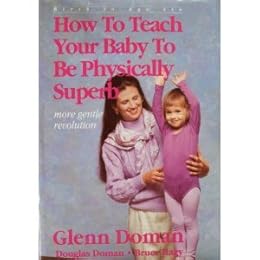
Beware with the book
Teach Your Baby to Be Physically Superb, it works! One of my sons was RUNNING and CLIMBING at 9 months old. This was early. His judgement was severely outstripped by his physical abilities and I am relieved that he lived through that stage. However, when this son was diagnosed with autism just before his fourth birthday, I found myself so grateful for having done the Physically Superb exercises. His great progress in recovery from autism and his lack of typical autistic clumsiness are attributed, I think, to following this book's pattern when he was a baby. I think the book could be called "
Physical Therapy You Can Do At Home With Your Baby."
As you can see, I'm a fan of this series. I felt it gave me an intellectual experience as a mother of young children and that has brought me so much growth. Good Luck! And don't be overwhelmed by the book's outline of work. Remember, every little bit your do for your child benefits him/her!! And just take it a day at a time. :)
And I'm going to end on another friend's comment on the Facebook post, "I think the most important part of
this article is describing 'joy'. You can list unlimited pages with reasons not to have kids but you can't really explain the word joy. It's not fun, it's not happiness, it's not worry-free, its not satisfaction but it is the culmination of creation, work and sacrifice and it might be the ultimate emotion that God gave us. Joy is rare and children bring it in abundance."
~Valerie Harmon